


Why You Wake Up With a Stiff Neck — and Why It’s Worse in Winter
A Brighton chiropractor on the “I slept funny” neck, what’s actually going on, and what helps.
You go to bed fine. You wake up and you can barely turn your head — checking the rear-view mirror means turning your whole body, and the side of your neck feels locked and tender. Most people put it down to having “slept wrong,” and that’s not far off. But there’s a clear mechanism behind it, and there’s a reason we see noticeably more of these cases here in Brighton and across North Brisbane once the cooler months set in.
Here’s what’s happening, how your pillow fits into it, and the options that help you move freely again.
What “sleeping wrong” actually does to your neck
Your neck is built to move. When you sleep, though, you can hold it in one awkward position for hours at a time — turned hard to one side, dropped down because a pillow has gone flat, or propped up too high. You don’t notice, because you’re asleep and not shifting around the way you would when awake.
Held at the end of its range for long enough, the small joints down the side of the neck (the facet joints) and the muscles around them get irritated. The body’s response is to guard — the surrounding muscles tighten protectively to stop you moving into the painful range. That guarding is what you feel in the morning: stiffness, a sharp catch when you turn, and tenderness down one side. Clinically this is often called an acute wry neck, and while it’s painful and alarming, it’s usually mechanical and settles with the right care.
So why is it worse in winter?
This is the part we genuinely notice in the clinic — the “I slept funny” presentations climb as the temperature drops. The cold isn’t directly injuring your neck, but it stacks the deck against you overnight in a few ways:
- Reduced circulation. In the cold your body narrows the blood vessels near the skin to conserve heat (vasoconstriction), which means less blood flow to the muscles around your neck and shoulders. They start the night stiffer and less pliable.
- Muscles tense to keep warm. Cold triggers a low-grade, sustained muscle contraction as a heat-conserving reflex — so the neck and shoulders are already carrying extra tension before you’ve moved a millimetre.
- You move less under the covers. Heavy blankets, curling up for warmth, and tucking your head down all mean you tend to hold one position for longer — exactly the setup that irritates a joint.
- Draughts and changing position. A cold draught across the bed, or pulling the doona up over a shoulder, nudges people into hunched, head-forward postures they’d never hold while awake.
Layer all that on top of a pillow that isn’t supporting your neck properly, and a position you’d normally shift out of becomes one you hold all night — colder, tighter, and more likely to leave you stiff by morning. The science behind cold and muscle stiffness is well established; what’s within your control is the setup you sleep in.
The cold doesn’t injure your neck — it just makes a poorly-supported sleeping position far more likely to bite.
Your pillow: the one thing most people get wrong
A pillow has one job: to keep your neck in a neutral position — the same gentle natural curve it holds when you’re standing with good posture. It should fill the gap between your head and the mattress so your neck is neither bent up nor dropping down. Get that right and you remove the single biggest overnight risk factor.
How to match the pillow to how you sleep
- Side sleepers need a higher, firmer pillow to fill the wider gap created by your shoulder, so your head doesn’t tilt down towards the mattress.
- Back sleepers usually do best with a lower or contoured pillow that supports the curve of the neck without pushing the head forward.
- Stomach sleeping is the hardest position on the neck — it forces your head to stay rotated all night. If you can retrain to your side or back, your neck will thank you.
A few practical checks: if your pillow has gone flat or lumpy, replace it — a sagging pillow gives no support. Foam and latex hold their shape far better overnight than old fibre-fill. And in winter, a warmer bedroom and keeping your neck out of a direct draught both help.
Our Soul Sleepers pillows
Because getting the right height for your sleeping position matters so much, we stock our own Soul Sleepers pillow range at the clinic — designed to support the natural curve of the neck and hold their shape through the night. When you’re in, we can look at how you sleep and help you choose the right profile rather than guessing off a shelf. A pillow isn’t a treatment on its own, but the right one removes a problem you’d otherwise recreate every single night.
How we help a stiff, locked-up neck
If you’ve woken up stuck, the good news is that a mechanical neck usually responds well to hands-on care. We tend to combine a few approaches depending on what we find on assessment:
Chiropractic adjustments and mobilisation
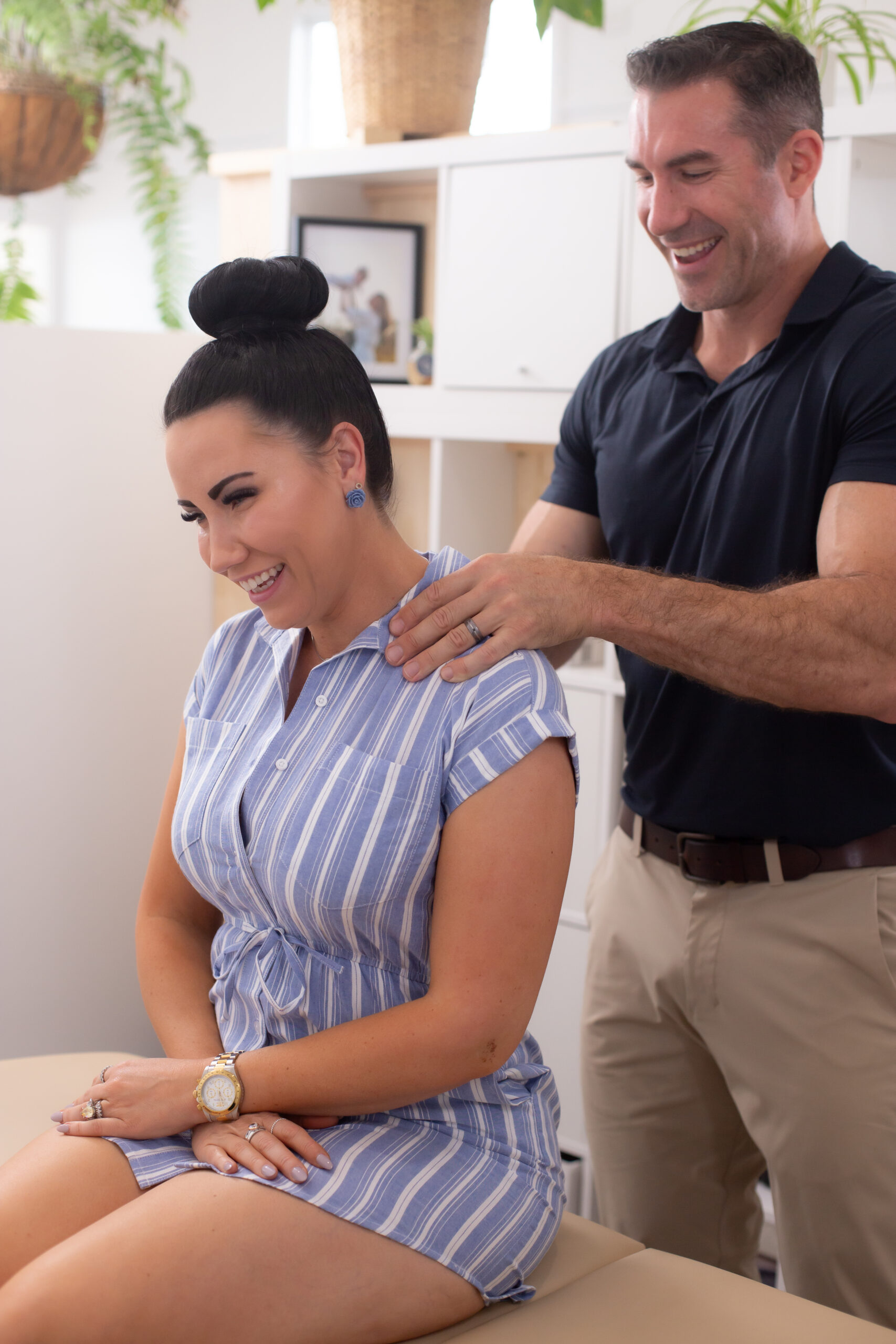
Gentle adjustment and mobilisation aim to restore movement to the stiff, guarded joints in the neck. For mechanical and acute neck pain, this can help ease pain and improve how far you can comfortably turn, often within the first few visits. We always assess first and tailor the technique to you — including gentler, lower-force options where they’re appropriate.
Soft tissue therapy
The muscles that tighten up with this kind of neck — the upper traps, levator scapulae and the small suboccipital muscles at the base of the skull — respond well to targeted soft tissue work. The aim is to release that protective tension, ease the pull on the joints, and encourage blood flow back into muscles that have been cold and tight.
Dry needling
Where there are tight, ropey bands or trigger points in the muscle, dry needling uses a fine needle into the muscle to help it release. Many people find it helpful for easing muscular neck tension and pain in the shorter term, and it pairs well with adjustment and soft tissue work as part of a combined plan.
Alongside hands-on care, we’ll usually give you a couple of simple things to do at home — gentle movement, heat over the tight muscles, and the pillow and posture tweaks above — so the improvement holds rather than coming straight back the next cold night.
When a stiff neck is worth getting checked
Most “slept wrong” necks ease within a few days. It’s worth booking an assessment if:
- the pain isn’t settling after a few days, or it keeps coming back
- it radiates down into your arm, or you have pins and needles, numbness or weakness in the arm or hand
- the pain came on suddenly and severely without an obvious cause
- the stiffness comes with a fever, or with dizziness
These don’t necessarily mean anything serious, but they’re worth assessing properly rather than waiting it out.
Woken up with a neck you can’t turn?
If winter keeps leaving you stiff and sore in the mornings, we can assess what’s going on, get you moving freely, and sort out the pillow and habits that are causing it. Call the Brighton clinic on 07 3608 8814 or book online at bodyandsoulchiro.au.